

Uncover Neodymium Iron Boron NdFeB Basics
Neodymium iron boron NdFeB is the material behind many compact, high-force permanent magnets used in motors, sensors, fixtures, medical devices, and industrial assemblies. For an engineer or buyer, the useful starting point is not simply that NdFeB is “strong.” The real question is whether a specified magnet can maintain the required flux, fit the assembly, tolerate its environment, and arrive with verifiable properties.
This overview explains what neodymium iron boron NdFeB is, what the grade markings mean, and which details should appear on a practical specification.
What is neodymium iron boron NdFeB?
Neodymium iron boron NdFeB is a rare-earth permanent-magnet family based mainly on neodymium, iron, and boron. Its principal magnetic phase is commonly written as Nd2Fe14B. The material is usually produced either as sintered NdFeB for maximum magnetic performance or as bonded NdFeB when a more complex molded shape, lower density, or different manufacturing route is needed.
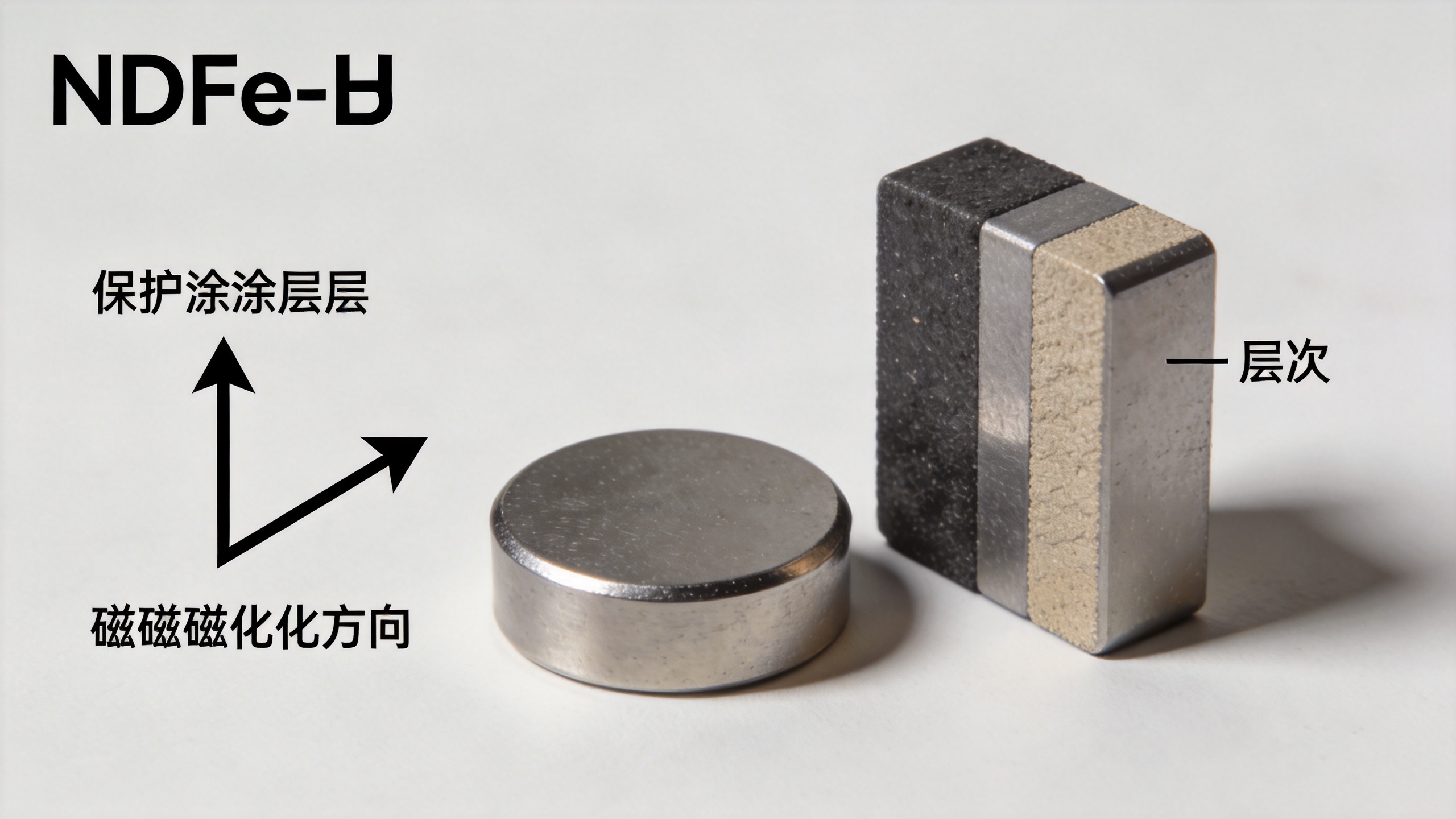
Sintered neodymium iron boron NdFeB has a high magnetic energy product for its size. Published reference ranges for sintered Nd2Fe14B include remanence of roughly 1.0–1.4 T, intrinsic coercivity of about 750–2,000 kA/m, and maximum energy product of roughly 200–440 kJ/m³. Those ranges are not a purchase specification: the tested value depends on grade, geometry, magnetization direction, temperature, and the supplier’s measurement method.
Why grade is only the first part of selection
A designation such as N35 or N52 is often treated as a simple strength ranking. In neodymium iron boron NdFeB, the number broadly relates to maximum energy product, so it is helpful for an initial comparison. It does not, by itself, prove that a magnet will work in a finished assembly.
High-temperature suffixes such as M, H, SH, UH, EH, and TH are associated with higher coercivity families. They can be relevant when heat or a demagnetizing field is present. If an application runs below 60°C continuously, a standard grade may be appropriate, but thermal cycling, adjacent steel, opposing magnetic fields, air gaps, and mechanical tolerances can change the design decision. The sensible sequence is to define the circuit and environment first, then select the grade.
| Specification item | Why it matters |
|---|---|
| Grade and magnetic-property limits | Sets the expected remanence, coercivity, and energy-product window. |
| Dimensions and tolerances | Controls fit, air gap, repeatability, and assembly force. |
| Magnetization direction | Determines how the field is oriented in the product. |
| Operating temperature and field exposure | Helps assess irreversible demagnetization risk. |
| Coating and environment | Addresses humidity, chemicals, abrasion, and handling exposure. |
Temperature: operating limit versus Curie temperature
Temperature is one of the most misunderstood neodymium iron boron NdFeB basics. A material’s Curie temperature is the point at which its ferromagnetic behavior is lost; published ranges for sintered NdFeB are often around 310–400°C. That figure is not a recommended operating limit. A magnet can lose useful performance or suffer irreversible loss well below the Curie point, depending on grade, shape, magnetic circuit, and opposing fields.
Ask for the maximum operating temperature for the specific grade and test conditions, not just a generic material statement. For critical designs, validate the assembled part at its actual hot spot and under its real demagnetizing load.
Why coating belongs in the drawing
Because neodymium iron boron NdFeB contains iron and has reactive rare-earth-rich regions, sintered magnets can be vulnerable to corrosion in humid or aggressive conditions. A coating is therefore a functional specification, not merely a cosmetic finish. Nickel-based multilayers, epoxy systems, zinc, and other treatments are selected differently depending on moisture, salt exposure, chemical contact, wear, electrical needs, and appearance.
No single coating choice fits every exposure environment. A nickel finish can suit many general industrial applications, while an epoxy coating may be considered where added barrier protection is needed. Coating thickness, adhesion, edge coverage, and the condition of the final assembly all matter. State the environment clearly and agree on an acceptance method rather than assuming a familiar finish solves every corrosion issue.
Common uses and practical limits
Neodymium iron boron NdFeB supports compact designs where a high field from a small volume is valuable. Typical uses include brushless motors, actuators, magnetic separators, sensor systems, holding fixtures, couplings, and consumer-electronics mechanisms. The same strength that makes NdFeB useful also requires careful handling: strong magnets can snap together, chip, pinch fingers, affect nearby magnetic media, and interfere with sensitive equipment.
NdFeB is also relatively brittle. A drawing should identify chamfers or edge requirements where appropriate, and packaging should prevent magnets from colliding during transit. If an application is safety-critical or highly regulated, the design team should validate the complete component and its installation rather than relying on catalog data alone.
A buyer’s checklist for an NdFeB request
- Describe the use case, target holding force or field requirement, and available space.
- Specify grade, shape, dimensions, tolerances, and magnetization direction.
- State continuous and peak temperatures, nearby magnetic materials, and opposing fields.
- Define the exposure environment and coating requirement.
- Request agreed inspection information for dimensions, coating, and magnetic properties.
- Confirm handling and shipping requirements for magnetized parts before release.
Final takeaway
Neodymium iron boron NdFeB offers exceptional magnetic capability in a compact package, but a grade name alone is not a finished engineering decision. A reliable specification connects magnetic performance with geometry, magnetization, temperature, corrosion protection, tolerances, and verification. That approach helps buyers compare like for like and gives suppliers the information needed to support a workable design.


