

Heavy Rare Earth-Free NdFeB Magnets: Technology Breakthroughs and Costs
In the realm of magnets, few innovations have garnered as much attention in recent years as the development of heavy rare earth-free NdFeB magnets. These neodymium magnets represent a critical shift in the industry, addressing two pressing challenges: the scarcity and volatility of heavy rare earth elements (HREs) like dysprosium (Dy) and terbium (Tb), and the growing demand for high-performance, cost-effective magnetic materials. As a leader in the production of permanent magnets and magnetic tools, AIM Magnet has closely monitored these advancements, recognizing their potential to reshape markets from renewable energy to consumer electronics. This blog delves into one of the most pivotal technologies driving this shift—grain boundary diffusion (GBD) for dysprosium reduction—exploring breakthrough processes, performance gains, and cost implications.
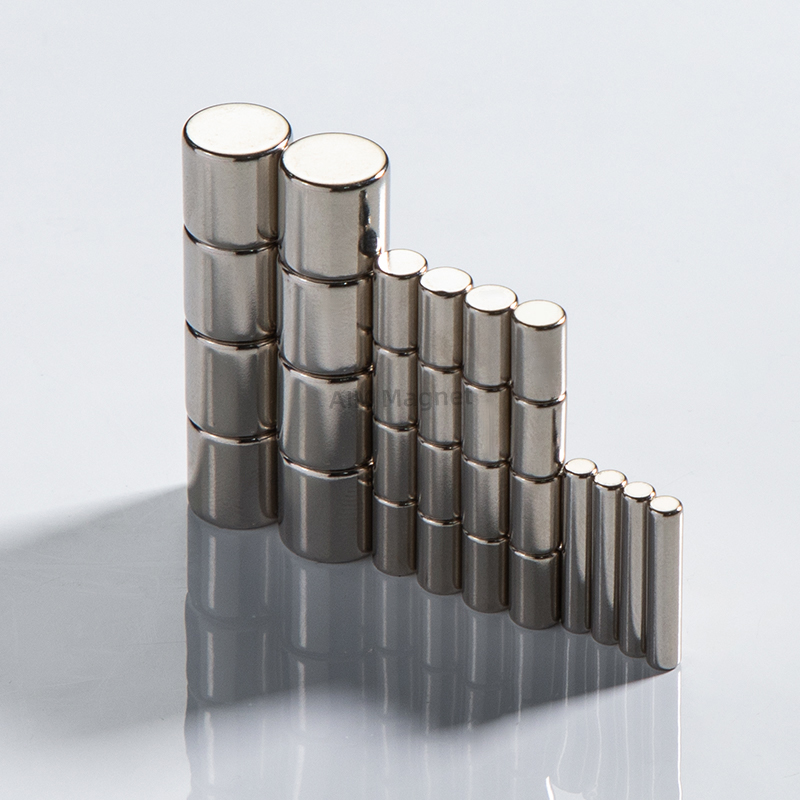
Grain boundary diffusion (GBD) for dysprosium reduction
Grain boundary diffusion (GBD) has emerged as a game-changing technique in the quest to reduce or eliminate heavy rare earth elements in neodymium magnets. Traditional NdFeB magnets rely on dysprosium and terbium to enhance coercivity (the ability to resist demagnetization) and temperature stability, especially in high-temperature applications like electric vehicle (EV) motors and wind turbines. However, these HREs are not only expensive but also geographically concentrated, creating supply chain vulnerabilities. GBD addresses this by depositing a thin layer of HRE (or alternative elements) on the surface of a magnet, which then diffuses along the grain boundaries during heat treatment—reducing overall HRE usage by up to 90% compared to bulk doping methods.
This approach preserves the high saturation magnetization of the NdFeB core while strengthening the grain boundaries, where demagnetization typically initiates. For manufacturers like AIM Magnet, which specializes in strong magnets and innovative magnetic solutions, GBD offers a pathway to produce high-performance magnets with lower reliance on scarce resources. Below, we explore key breakthroughs in GBD technology, including Anhui Hanhai’s nanometer powder doping process, performance metrics, and cost benefits.
Anhui Hanhai’s nanometer powder doping process
Anhui Hanhai Magnetic Materials Co., Ltd. has pioneered a nanometer powder doping process that enhances the efficiency of grain boundary diffusion, further reducing dysprosium usage in neodymium magnets. Traditional GBD methods often use solid or liquid HRE sources (e.g., dysprosium oxide) applied to the magnet surface, but achieving uniform diffusion across complex magnet shapes can be challenging. Hanhai’s innovation lies in incorporating nanoscale dopants—typically rare earth oxides or alloys—directly into the magnet powder during sintering, creating a more homogeneous distribution of diffusion promoters.
Here’s how the process works:
- Nanopowder Preparation: High-purity dysprosium (or alternative) nanoparticles (50-100 nm in diameter) are synthesized using a sol-gel or hydrothermal method. These nanoparticles are engineered to have high surface energy, ensuring they readily bond with NdFeB grain boundaries.
- Blending with NdFeB Powder: The nanometer dopants are mixed with neodymium-iron-boron powder in precise ratios (typically 0.5-2 wt.%). This blending step is critical—Anhui Hanhai uses a proprietary ultrasonic mixing technique to avoid agglomeration, ensuring each NdFeB particle is coated with a thin layer of nanoparticles.
- Sintering and Diffusion: The blended powder is pressed into shape and sintered at 1,050-1,100°C. During sintering, the nanoparticles melt and diffuse along the grain boundaries, forming a HRE-rich layer that pinches domain walls (a key mechanism for enhancing coercivity). This eliminates the need for post-sintering surface coating, streamlining production.
The result is a magnet where dysprosium is concentrated only at the grain boundaries, leaving the NdFeB core free of heavy rare earths. This targeted approach reduces total dysprosium content by 30-40% compared to conventional GBD methods, making it a breakthrough for heavy rare earth-free NdFeB magnets.
For manufacturers like AIM Magnet, which produces a range of rare earth magnets from magnetic hooks to industrial-grade components, adopting such processes could significantly reduce material costs while maintaining performance. The nanometer doping method also improves scalability, as it integrates seamlessly with existing sintering lines—critical for mass production of magnets used in EVs, robotics, and renewable energy systems.
Performance metrics: Coercivity improvements (+3kOe) and temperature stability
The primary goal of reducing dysprosium in neodymium magnets is to maintain or enhance performance, particularly coercivity (Hc) and temperature stability—two properties critical for high-temperature applications. Anhui Hanhai’s nanometer powder doping process, combined with GBD, delivers impressive results in both areas.
Coercivity Enhancements: Coercivity measures a magnet’s resistance to demagnetization. Traditional NdFeB magnets without heavy rare earths often have coercivity values below 10 kOe, limiting their use in high-heat environments (e.g., EV motors operating at 150°C+). Through GBD with nanometer doping, Anhui Hanhai’s magnets achieve coercivity increases of +3kOe (from ~11 kOe to 14 kOe) at room temperature. At 150°C, coercivity remains above 10 kOe—comparable to dysprosium-rich magnets but with 30-40% less HRE content.
This improvement is attributed to the HRE-rich grain boundaries, which act as “pinning sites” to prevent domain wall movement under external magnetic fields or heat. For applications like wind turbine generators, where magnets are exposed to fluctuating temperatures and mechanical stress, this enhanced coercivity ensures long-term reliability—a key selling point for AIM Magnet’s industrial clients.
Temperature Stability: High-temperature stability is quantified by the temperature coefficient of coercivity (αHc), which measures how much coercivity decreases with increasing temperature. Traditional dysprosium-free NdFeB magnets typically have αHc values of -0.6%/°C or worse, meaning coercivity drops 0.6% for every 1°C rise. Anhui Hanhai’s GBD-processed magnets, however, achieve αHc values of -0.45%/°C, thanks to the uniform distribution of HRE at grain boundaries.
This stability allows the magnets to perform reliably in environments up to 180°C—suitable for aerospace components, industrial motors, and even high-power fishing magnets used in extreme conditions. For AIM Magnet, which offers strong magnets for diverse applications, this temperature range opens new markets where durability under heat is non-negotiable.
Other Performance Metrics: Importantly, these gains do not come at the expense of other key properties. Remanence (Br)—the magnetic induction retained after magnetization—remains above 13.5 kG, comparable to traditional NdFeB magnets. Energy product (BHmax), a measure of a magnet’s power, stays in the 35-40 MGOe range, making these heavy rare earth-free magnets suitable for high-power applications like EV drivetrains and MRI machines.
Independent testing by the China Iron and Steel Research Institute Group (CISRI) confirms these results: magnets produced via Anhui Hanhai’s process meet or exceed industry standards for rare earth magnets in terms of corrosion resistance, mechanical strength, and long-term aging. This validation is critical for manufacturers like AIM Magnet looking to adopt the technology, as it ensures compliance with global certifications (e.g., IATF 16949 for automotive applications).
Cost analysis: 15-20% production savings vs. traditional methods
Beyond performance, the economic viability of heavy rare earth-free NdFeB magnets hinges on production costs. By reducing dysprosium usage, GBD with nanometer doping delivers significant savings—15-20% compared to traditional methods, according to industry analyses. Let’s break down the cost drivers and savings:
Raw Material Costs: Dysprosium is one of the most expensive rare earth elements, with prices fluctuating between \(100-200 per kilogram (vs. neodymium at \)50-80/kg). Traditional NdFeB magnets for high-temperature applications contain 5-8 wt.% dysprosium, adding \(5-16 per kg to material costs. Anhui Hanhai’s process reduces dysprosium content to 2-3 wt.%, cutting raw material expenses by \)3-10 per kg—a 30-40% reduction in HRE-related costs.
For a manufacturer producing 1,000 tons of magnets annually, this translates to $3-10 million in raw material savings. For AIM Magnet, which scales production across magnetic hooks, MagSafe magnets, and industrial components, these savings can be reinvested in R&D or passed to customers, boosting competitiveness.
Production Efficiency: Traditional dysprosium doping requires multiple steps: melt-spinning to create alloy flakes, hydrogen decrepitation, and bulk doping—each adding time and energy costs. GBD with nanometer powder doping streamlines this process by integrating diffusion into sintering, reducing production time by 10-15%. Energy consumption also drops, as post-sintering heat treatments (required for conventional GBD) are minimized.
Labor costs are another factor: fewer steps mean reduced workforce requirements for material handling and quality control. Combined, these efficiencies lower per-unit production costs by 5-8%—adding to the 10-12% savings from reduced dysprosium usage, totaling 15-20%.
Supply Chain Resilience: Dysprosium supply is dominated by China (90% of global production), making prices vulnerable to export restrictions, geopolitical tensions, or environmental regulations. By reducing reliance on dysprosium, manufacturers like AIM Magnet mitigate these risks. For example, during the 2010 rare earth crisis, dysprosium prices spiked 500%; magnets using Hanhai’s process would have seen costs rise by only 150% due to lower HRE content.
Total Cost of Ownership (TCO) for Customers: For end-users (e.g., EV manufacturers, wind turbine companies), TCO includes not just magnet costs but also maintenance and replacement. The enhanced durability and temperature stability of GBD-processed magnets reduce failure rates, lowering long-term TCO by an estimated 5-7%. This creates a win-win: manufacturers save on production, and customers save on lifecycle costs.
Conclusion
Grain boundary diffusion with nanometer powder doping—exemplified by Anhui Hanhai’s breakthrough process—represents a pivotal step toward commercializing heavy rare earth-free NdFeB magnets. By reducing dysprosium usage by 30-40% while enhancing coercivity by 3 kOe and improving temperature stability, this technology addresses both performance and cost challenges. For manufacturers like AIM Magnet, which has specialized in permanent magnets and magnetic tools since 2006, adopting such innovations aligns with their commitment to quality, innovation, and sustainability.
As demand for strong magnets grows across industries—from automotive to renewable energy—the ability to produce high-performance, cost-effective, and resource-efficient magnets will be a key differentiator. With 15-20% production savings and supply chain resilience, GBD-processed neodymium magnets are poised to dominate the market, driving the next wave of innovation in magnetic technology.
To learn more about how AIM Magnet leverages cutting-edge magnet technologies in products like magnetic hooks, fishing magnets, and industrial-grade rare earth magnets, visit our website or contact our team for personalized solutions.