

Strong Industrial Neodymium Magnets: Key Benefits
As a magnetic materials technical advisor, one observation comes up consistently: industrial buyers often approach neodymium magnet selection by asking which grade is the strongest — when the more useful question is which combination of grade, coating, and geometry most closely matches the actual operating conditions. That said, the performance case for strong industrial neodymium magnets across demanding applications is well-grounded. Here is a structured overview of the key benefits that make them a preferred choice for engineers and procurement managers working across motor, sensor, actuator, and coupling design.
1. Highest Energy Density Among Commercial Permanent Magnets
Neodymium-iron-boron (NdFeB) magnets deliver the highest maximum energy product (BH)max among commercially available permanent magnet families, exceeding 400 kJ/m³ at room temperature in advanced sintered grades. In practical terms, this means a strong industrial neodymium magnet can produce the same magnetic field as a significantly larger ferrite or alnico magnet. For industrial designs where weight, size, and packaging constraints are real engineering constraints rather than theoretical preferences, this energy density advantage translates directly into smaller assemblies and reduced mass without compromising holding or actuation force.
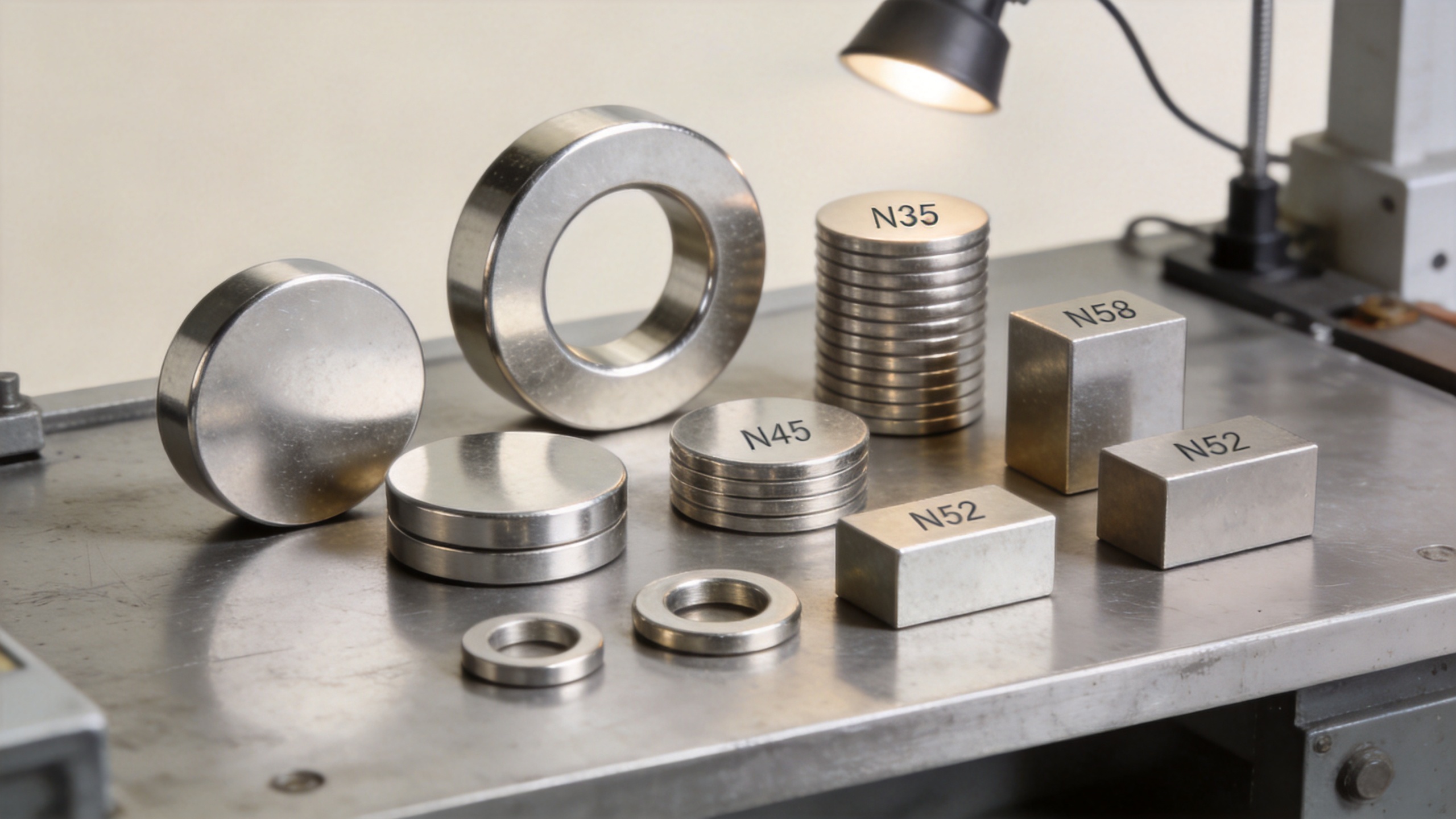
Grades ranging from N35 to N52 provide a calibrated performance ladder, with N52 carrying a nominal energy product of approximately 52 MGOe. If your application runs under steady-state conditions below 60°C with moderate pull force requirements, N35 or N38 is usually sufficient and offers a meaningful cost advantage over higher grades. However, if thermal cycling or continuous operation brings the assembly close to the magnet's rated operating limit, the performance picture shifts, and selecting a higher-energy grade or a thermally rated variant becomes a justified engineering decision rather than over-specification.
2. Compact Footprint with Substantial Pull Force
The strength-to-volume ratio of strong industrial neodymium magnets is what most engineers cite first, and it is worth examining what this ratio actually enables in practice. In linear actuator and magnetic coupling designs, the ability to achieve the required holding or transfer force within a tightly constrained installation envelope often determines whether a magnetic solution is viable at all.
Pull force ratings and working clearance behavior are not the same concept, and the distinction matters in practice. In my experience specifying magnets for industrial assemblies, the working clearance question is often more consequential than the peak pull force figure once you reach production stage. A magnet rated for high pull force at contact may see substantially different effective force at the operating air gap in the actual assembly. Grade and geometry together determine the performance curve across clearance. Catalog specifications alone do not consistently reflect this relationship.
3. Broad Grade Range Enables Precise Application Matching
One of the structural advantages of sourcing strong industrial neodymium magnets from a supplier covering N35 through N52 and thermally rated series is that specification changes during the design-in phase do not require switching suppliers or managing multiple supply chains. For OEM procurement teams managing multiple product lines with different magnetic performance requirements, access to a consistent grade range from a qualified supplier reduces qualification overhead.
The grade selection process itself involves a direct trade-off between energy product and cost — choosing the right grade means matching performance to the requirement, not defaulting to the highest available grade. Selecting a higher-than-necessary grade adds cost without delivering application benefit, while under-specifying introduces performance risk. The relevant benchmark is the actual field requirement in the assembly, not an abstract strength ranking.
4. Multiple Coating Options for Industrial Environment Protection
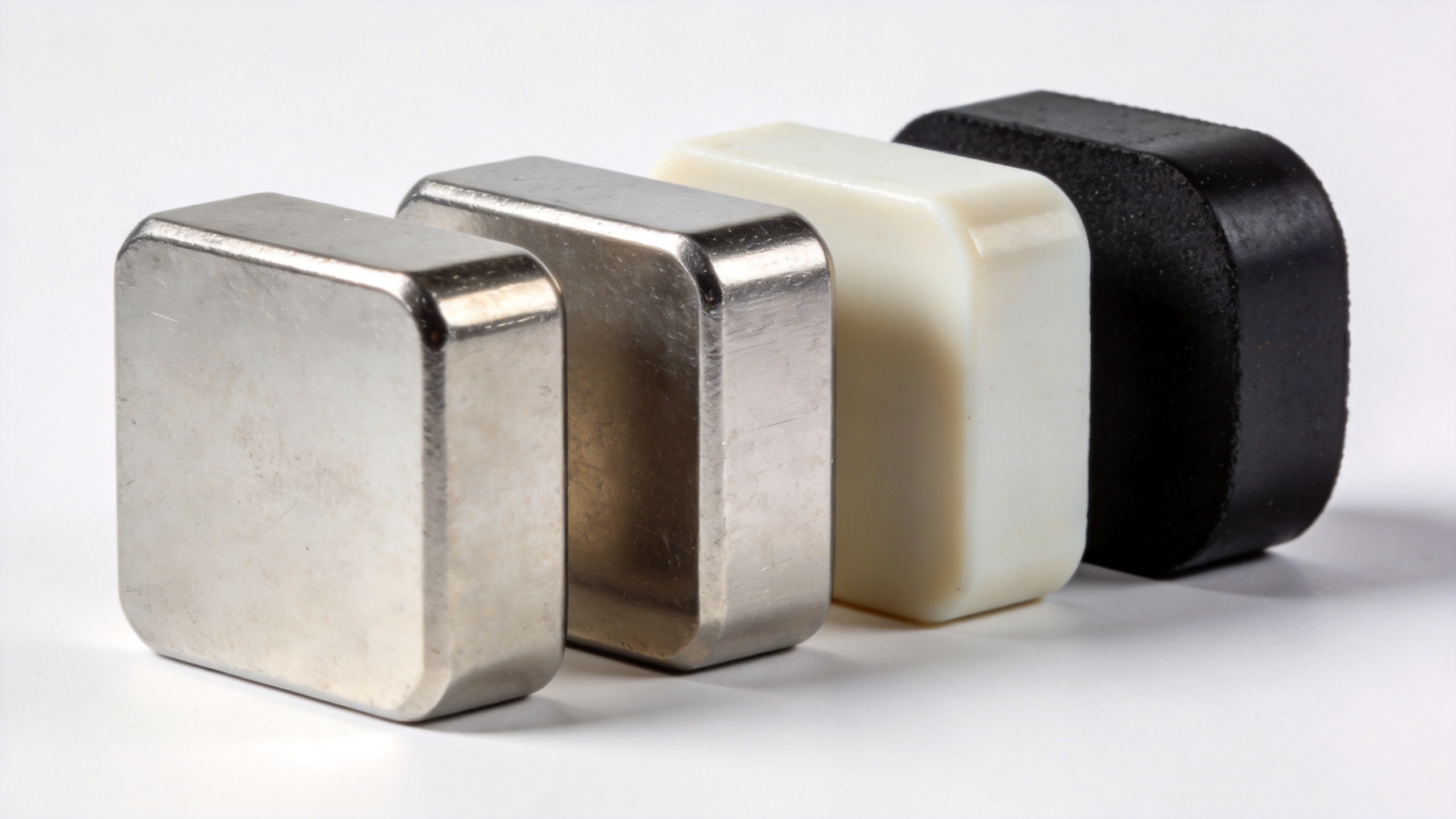
NdFeB magnets are susceptible to corrosion without surface protection, a practical constraint that becomes material in industrial environments involving moisture, chemical exposure, or mechanical contact. The availability of multiple coating options — nickel, epoxy, gold, zinc, and rubber among them — from a single supplier allows procurement and engineering teams to match corrosion protection to the actual deployment environment without fragmenting the supply base.
Nickel coating covers a wide range of standard industrial applications and offers a good balance of protection and dimensional consistency. Epoxy coating provides stronger chemical resistance for more aggressive environments. Rubber-coated variants add impact protection and electrical isolation in applications where the magnet surface may contact sensitive components. What matters for sourcing decisions is not simply having coating options listed in a catalog, but confirming that the selected coating is applied consistently across production batches and verified through incoming inspection.
5. High-Temperature Grade Variants for Demanding Industrial Applications
Standard N-series neodymium magnets have rated maximum operating temperatures in the range of 80°C for N-grade and up to 120°C for M-grade variants. Applications involving industrial motors, automotive subsystems, or elevated-temperature process environments may require SH, UH, or EH grade magnets, which extend the continuous operating range. High-temperature grades achieve this through modified coercivity characteristics — the resistance to demagnetization under combined thermal and opposing field conditions — rather than simply through a higher energy product.
Missing the thermal specification at the design stage is one of the more common and costly sourcing errors in industrial magnet procurement. The operating temperature in a motor assembly under load often differs from the ambient temperature by a significant margin. Confirming the actual operating temperature range, ideally with measured data rather than estimates, before finalizing grade selection is a straightforward step that prevents performance degradation and premature field failures.
6. Custom Geometry Capability for OEM Design Integration
Beyond catalog disc, block, and ring geometries, strong industrial neodymium magnets are available in custom dimensions and configurations to accommodate OEM-specific assembly requirements. For design engineers integrating magnetic components into tight-tolerance assemblies, the ability to specify custom dimensions, magnetization direction, and surface finish from a supplier with controlled dimensional tolerances is a meaningful qualification criterion.
Custom geometry orders require clear specification of dimensional tolerances, magnetization axis, and coating requirements from the outset. Dimensional variability across production batches is a known issue in magnet sourcing. Confirming tolerance capability and the supplier's inspection protocol before committing to a production order reduces downstream fit and assembly problems.
Sourcing Considerations for Industrial Buyers
The key benefits of strong industrial neodymium magnets — energy density, compact form factor, grade range, coating variety, thermal variants, and custom geometry support — are most reliably captured when the supply chain includes a qualified neodymium magnet specialist capable of providing consistent batch quality, material certificates, and application-level technical support. For B2B procurement teams evaluating magnetic component suppliers, the combination of technical depth and supply chain reliability is the relevant evaluation framework, not simply unit cost or catalog breadth.
MSuper - AIM Magnet, operating from Shenzhen, offers a range of strong industrial neodymium magnets covering standard and high-temperature grades, multiple coating options, and custom geometry services. For procurement and engineering teams in the sourcing process, pre-sales technical consultation is available to support grade and specification confirmation before order placement.


