
From MagSafe to Qi2: How Apple's Magnetic Ecosystem Became a Global Industry Standard
In October 2020, Apple introduced MagSafe for iPhone 12 — a ring of magnets around the wireless charging coil that enabled snap-on chargers, wallets, and stands. What started as a proprietary Apple feature has become the foundation of a global cross-platform standard. Here's how Qi2 turned one company's innovation into an industry-wide revolution.
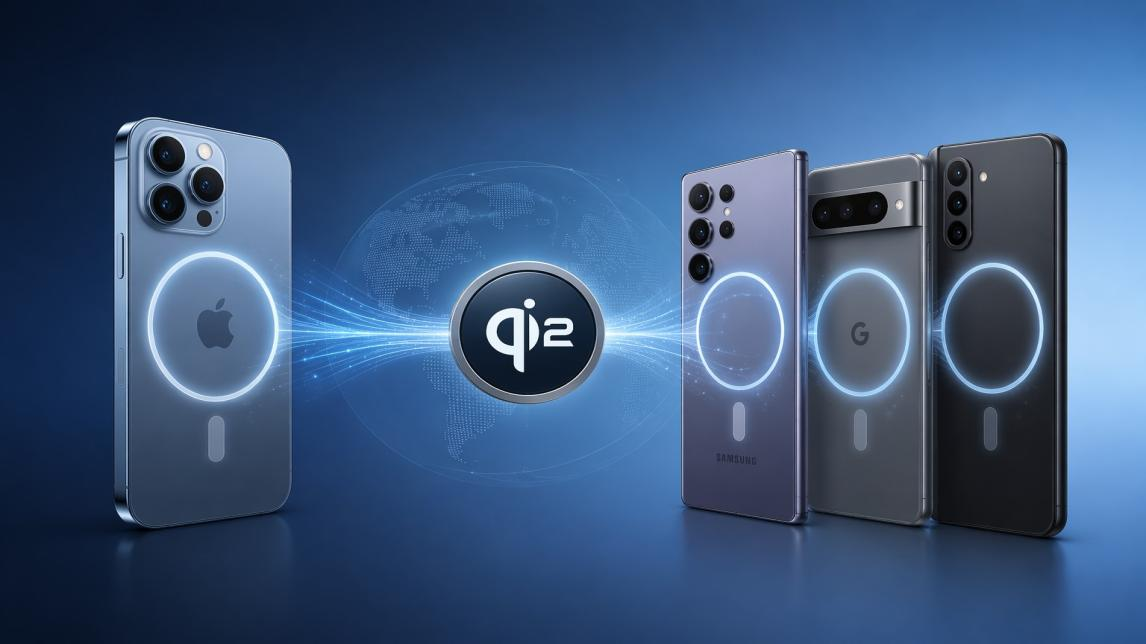
Timeline: MagSafe → Qi2
- 2020 Q4: MagSafe debuts on iPhone 12 — Apple-only ecosystem, proprietary
- 2021–22: Third-party "MagSafe-compatible" market explodes — no certification, inconsistent quality
- 2023 Q1: WPC announces Qi2 with Apple's MPP contribution — MagSafe magnet spec goes public
- 2024 Q3: Qi2.1 released — 100+ Qi2-certified products on market
- 2025 Q3: Qi2.2 (25W) announced — Samsung Galaxy S25 + Google Pixel 10 adopt Qi2 — Android ecosystem opens
- 2026+: Qi2 becomes default wireless charging standard — 550M+ phones/year
Why Apple Opened MagSafe to WPC
1. Regulatory Pressure
The EU's Common Charger Directive (USB-C mandate) signaled that proprietary charging ecosystems would face increasing regulation. By contributing MagSafe to WPC before being forced to, Apple retained influence over the standard's technical direction and avoided anti-competitive scrutiny.
2. Accessory Revenue
Apple earns licensing revenue from MFi accessories. By making the magnetic spec an open standard, Apple expanded the total addressable market for magnetic accessories and positioned MagSafe as the premium tier within a broader Qi2 ecosystem.
The Magnet Spec: How MagSafe Became Qi2
|
Parameter |
MagSafe (2020) |
Qi2 MPP (2023) |
|
Ring diameter |
56 mm (approx.) |
56 ±0.05 mm |
|
Magnet array |
18 segments |
18–36 segments |
|
Certification |
None (proprietary) |
WPC Qi2 certified |
Backward compatibility is built in: every MagSafe accessory since 2020 works with Qi2-certified phones, and every Qi2-certified accessory works with iPhones.
The Android Opportunity: A Massive New Market
Prior to 2025, the magnetic accessory market was iPhone-only — roughly 1.5 billion active iPhones. With Samsung and Google adopting Qi2:
- Samsung Galaxy S25/S26 series: ~300 million annual shipments
- Google Pixel 10/11: ~10 million annual shipments
- Xiaomi / OPPO / OnePlus expected to follow in 2026–2027
Total Qi2-compatible phone shipments projected from ~230M (2024, iPhone only) to 550+ million annually by 2028.
NdFeB Demand Impact
|
Assumption |
Value |
|
Qi2 phones shipped (2028) |
550 million units/year |
|
Accessories per phone (avg) |
1.8 units |
|
Magnet ring weight (N52) |
~2.5 grams |
|
Total NdFeB demand (2028) |
~2,475 tons/year |
Qi2 alone could account for 30%+ of consumer electronics NdFeB by 2030.
Supplier Tiers
- Tier 3 — Commodity: Standard shapes, lowest price, no cert support. Target: budget, non-certified.
- Tier 2 — Certified: Qi2-spec rings, basic traceability. Target: mid-tier brands.
- Tier 1 — Solutions Partner: WPC cert support + simulation + ±0.02mm + SPC. Target: Anker, Belkin, Mophie, ESR.
Future Trends
- Ultra-Thin (< 0.6mm): For ultrabooks/tablets, requires N52SH+ and precision grinding
- Magnet + NFC Assemblies: Pre-assembled modules capturing more value chain
- Recycled Rare Earth: EU regulations pushing recycled NdFeB content by 2028
Key Takeaways
- Qi2 transforms a proprietary Apple feature into a global cross-platform standard
- Android market opening is the single largest demand catalyst for Qi2 magnet rings
- 2,500+ tons/year NdFeB demand by 2028
- Magnet suppliers investing in certification + simulation capture the premium tier
About Aim Magnet
We've been supplying precision NdFeB magnets since Qi2 was still "the new MagSafe." Our engineering team provides full support from concept to mass production, including magnetic simulation, WPC pre-compliance data, and certified ±0.02 mm precision manufacturing.


